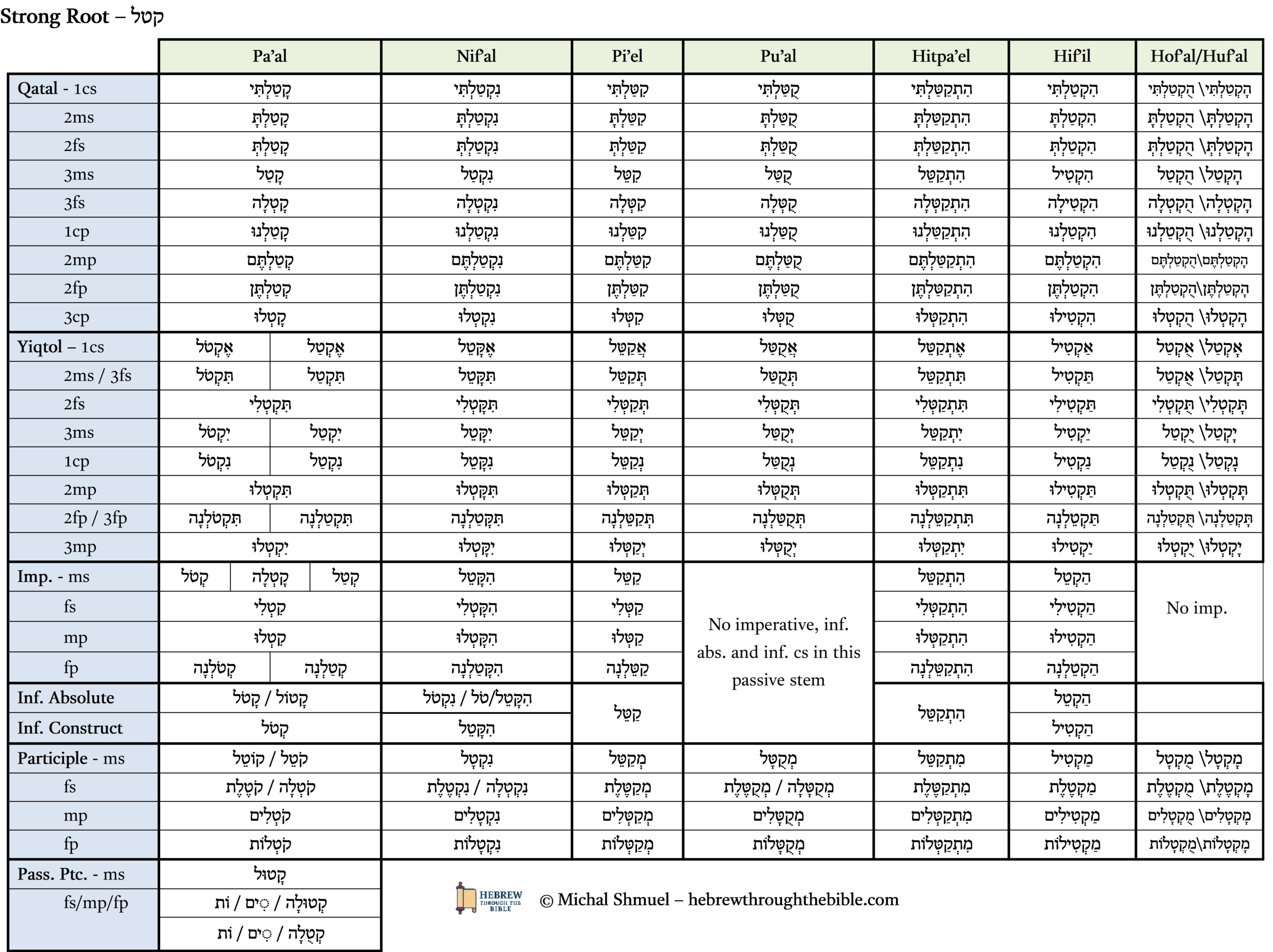
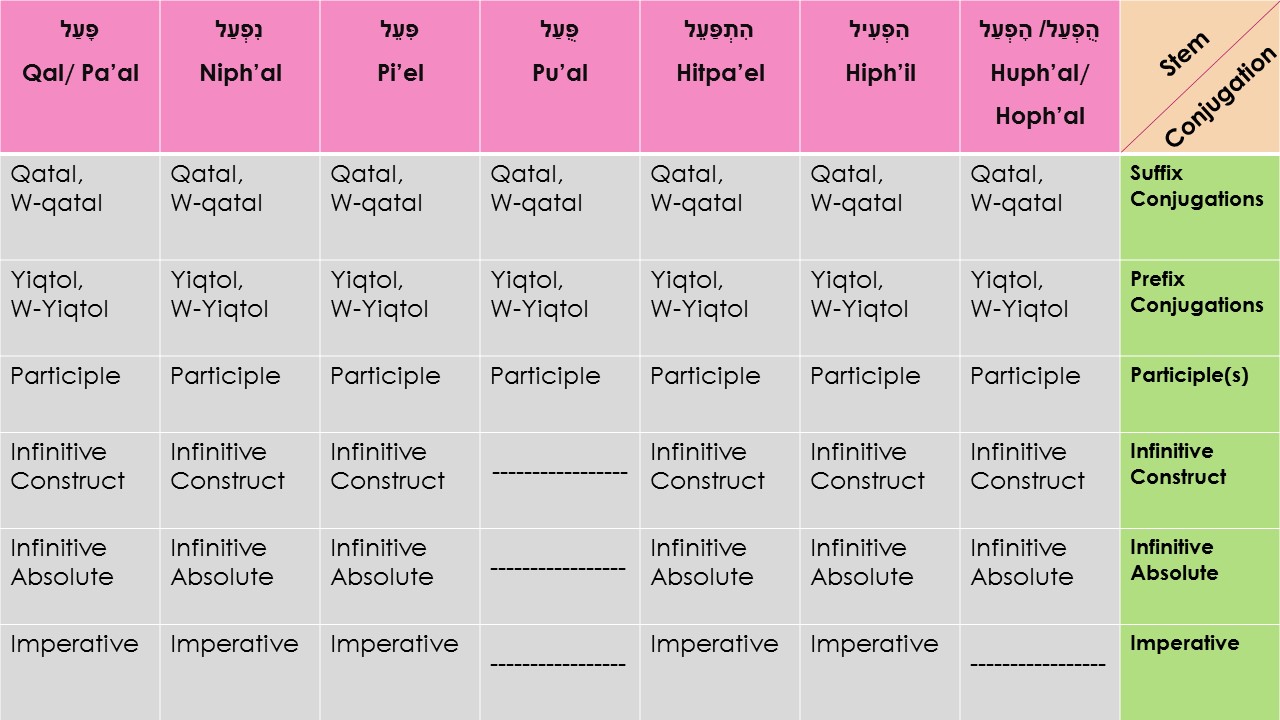
Summary of behavior in all the seven stems in Biblical Hebrew (unless otherwise indicated)
- Whenever the verb form has no suffix, the י that would appear at the end of the verb form (compared to the strong verb) is replaced by the vowel consonant ה.
Qatal – 3ms (citation form in lexicons and vocabulary lists)
Yiqtol – 1cs, 2ms, 3fs, 3ms, 1cp
Imperative – ms
Infinitive Absolute
Participle – ms - Whenever the suffix on the verb begins with a consonant, the yod is preserved in the verb form, but functions as a vowel consonant.
Qatal – 1cs, 2ms, 2fs, 1cp, 2mp, 2fp
Yiqtol – 2fp, 3fp
Imperative – fp - Whenever the suffix on the verb is or begins with a vowel, the י drops completely. Therefore, the suffix is directly attached to the second root consonant of the verb.
Qatal – 3cp
Yiqtol – 2fs, 3mp
Imperative – fs, mp
Participle – fs, mp, fp
Additional Forms:
Qatal – 3fs
In this form the י dropped off. There is an additional ת between the second root consonant and the 3fs suffix.
Infinitive Construct
The infinitive construct drops the י and adds the ending וֹת
Passive Participle Qal
This is the only place within the lamed-yod verbs where the י is found as the third root consonant without dropping the י and without changing it into the vowel letters ה or י.
Wayyiqtol
In comparison to the four Yiqtol forms that end in a vocalic ה (1cs, 2ms, 3fs, 1cp), Wayyiqtol drops this syllable. The four verb forms end with the second root consonant.
Jussive
The Jussive forms 3ms, 3fs, and 2ms drop the vocalic ה at the end.
Cohortative
Both cohortatives, 1cs and 1cp look exactly like Yiqtol.